

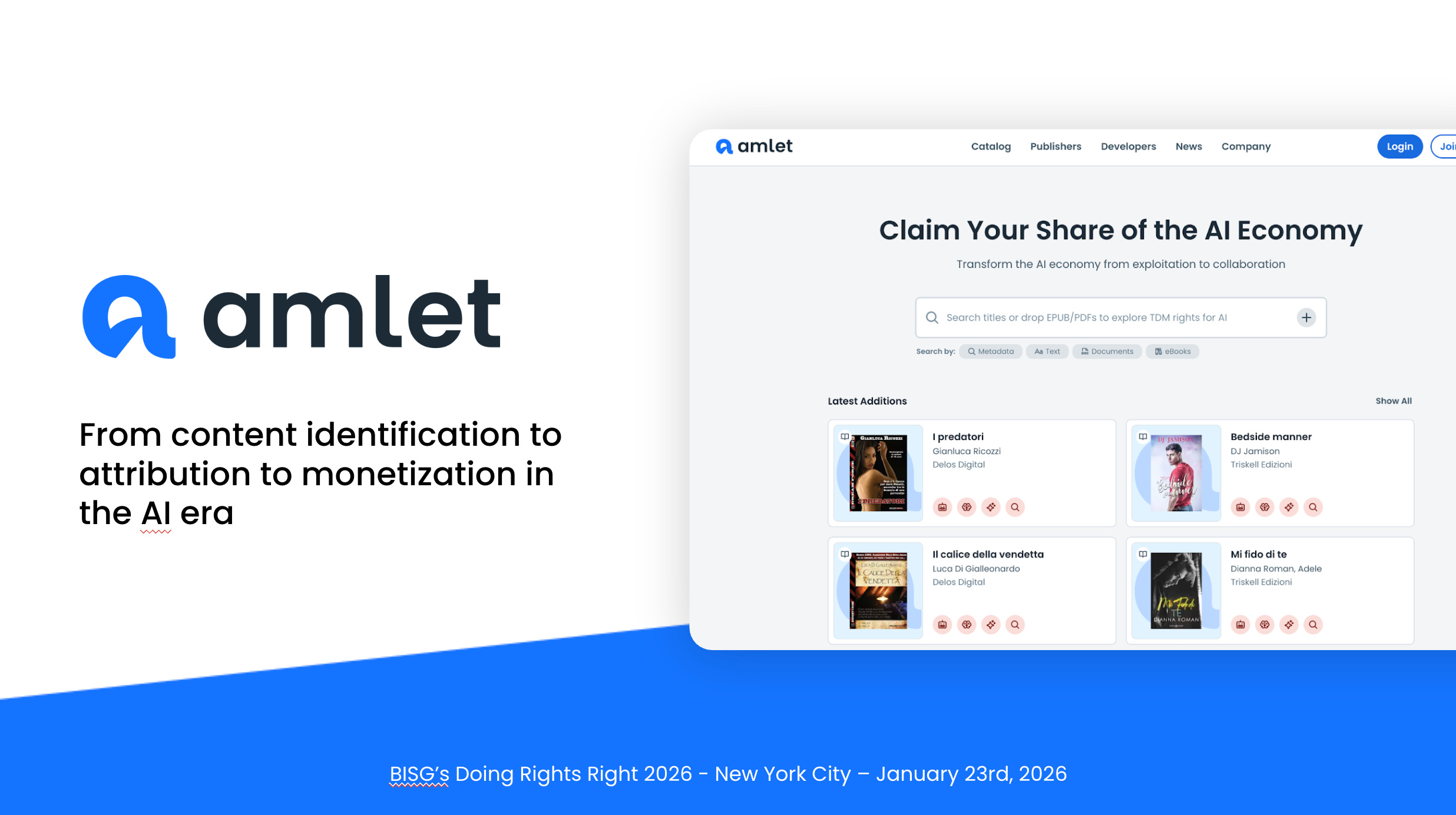
Last week I had the opportunity to speak at the BISG Doing Rights Right event in New York City, a conference focused on sharing best practices, tools, and perspectives on book rights and licensing. The audience included publishing executives, rights and legal teams, literary agents, and professionals responsible for protecting and monetizing editorial catalogs. The agenda covered a wide range of topics, all approached with the pragmatic mindset that defines BISG initiatives.
At Amlet.ai we are just getting started, and the invitation was a valuable and humbling opportunity to test our assumptions and engage openly with the industry.
My goal was to share our perspective on how book publishing infrastructure needs to evolve if the industry wants to continue supporting a healthy diversity of voices, languages, cultures, and worldviews.
Our thesis
I began the talk with a simple observation: today, the primary consumers of written content are often machines rather than human readers. Books are continuously indexed, analyzed, and reused by search engines, recommendation systems, and AI models used for training, retrieval, and inference.
These forms of usage are becoming structural, while most digital publishing infrastructure still assumes content is consumed exclusively by humans.
AI systems operate at machine-scale. They process vast amounts of content continuously, and this shift is happening much faster than contractual practices, collective licensing schemes, or enforcement mechanisms can realistically adapt. Copyright law and publishing contracts were built around human reading, while content today is not only read, but also processed, extracted, and learned from at an unprecedented scale.
This machine-driven consumption does not replace human readership, but exists alongside it and represents a distinct new layer of demand that, with the right infrastructure in place, can open up new monetization opportunities for book publishers.
Our approach
With Amlet.ai, we are building a platform that enables book publishers to make their content discoverable, clearly express their rights, and monetize it within a machine-driven economy.
We are not trying to replace existing commercial relationships or licensing strategies, but to provide shared infrastructure that enables additional remuneration from machine-driven consumption, because we believe this opportunity for publishers and authors could be larger than in any previous digital revolution.
Everything starts with identification, because AI systems cannot pay for content they cannot reliably recognize. Traditional identifiers such as the ISBN are no longer sufficient in a machine-driven environment, as AI systems need to index, search, and identify content at a granular level rather than at the level of finished book products. This is why a content-based identifier is needed, one that emerges directly from the content itself. This is where the International Standard Content Code, or ISCC, comes in.
Amlet is built on top of the ISCC open source technology stack. As an open standard, the ISCC provides content-based digital fingerprints that enable interoperability across systems and stakeholders. It works across media types, allowing books, audio, images, and video to be handled within a single framework, and as an ISO standard it offers a level of global recognition and trust that is essential for long term adoption.
On top of this foundation, Amlet provides a registry of usage rights attributes, also known as Text and Data Mining (TDM) attributes.
The Amlet Registry allows rightsholders to express their content usage rights for AI systems in a public, machine-readable way. At the same time, it enables AI systems to discover those rights through a central public interface via simple API connections, providing a compliance layer that allows AI training and AI inference to happen in line with declared rights.
Finally, Amlet includes a monetization layer designed to be highly scalable and to support platform-driven pricing for long-tail AI usage, for publishers who choose to allow AI companies to access and remunerate their content. This layer, including pricing for AI usage, remains fully under publishers control, reflecting the fact that different publishers will make different choices.
What we are building with Amlet reflects a vision in which AI systems can evolve and deliver better services and productivity while respecting the intellectual property of rightsholders and relying on high quality, trustworthy content. With the right infrastructure in place, this can unlock new monetization opportunities for publishers and authors and help human creativity continue to thrive.
I very much appreciated the opportunity to engage directly with thoughtful and sometimes challenging questions from the audience, and I am very grateful to the BISG team for the invitation to participate.
If you are interested, you can find the presentation at the following link: https://speakerdeck.com/giacd/amlet-from-content-identification-to-attribution-to-monetization-in-the-ai-era
You are welcome to reach me at giac@amlet.ai if you would like to continue the conversation.
This piece is incredibly timely, and your presentation at BISG sounds truly insightful. Your observation that machines are becoming primary content consumers is crucial. It highlights a structural shift with profound implications for how we concieve of copyright and digital infrastructure. Thank you for articulating this so clearly, especially for supporting diverse voices.