

At Amlet we are building content infrastructure for the AI era, and we are building it on open protocols and open source technology standardised by ISO. That choice is deliberate. No publisher or rightsholder should ever be locked into a proprietary system, or hand control of their business to yet another “tech company”.
This has always mattered, but it matters far more now, because we are living through the biggest technological revolution of our lifetimes and the decisions being made today will shape culture and society as we go forward.
As of today, all of this is running:
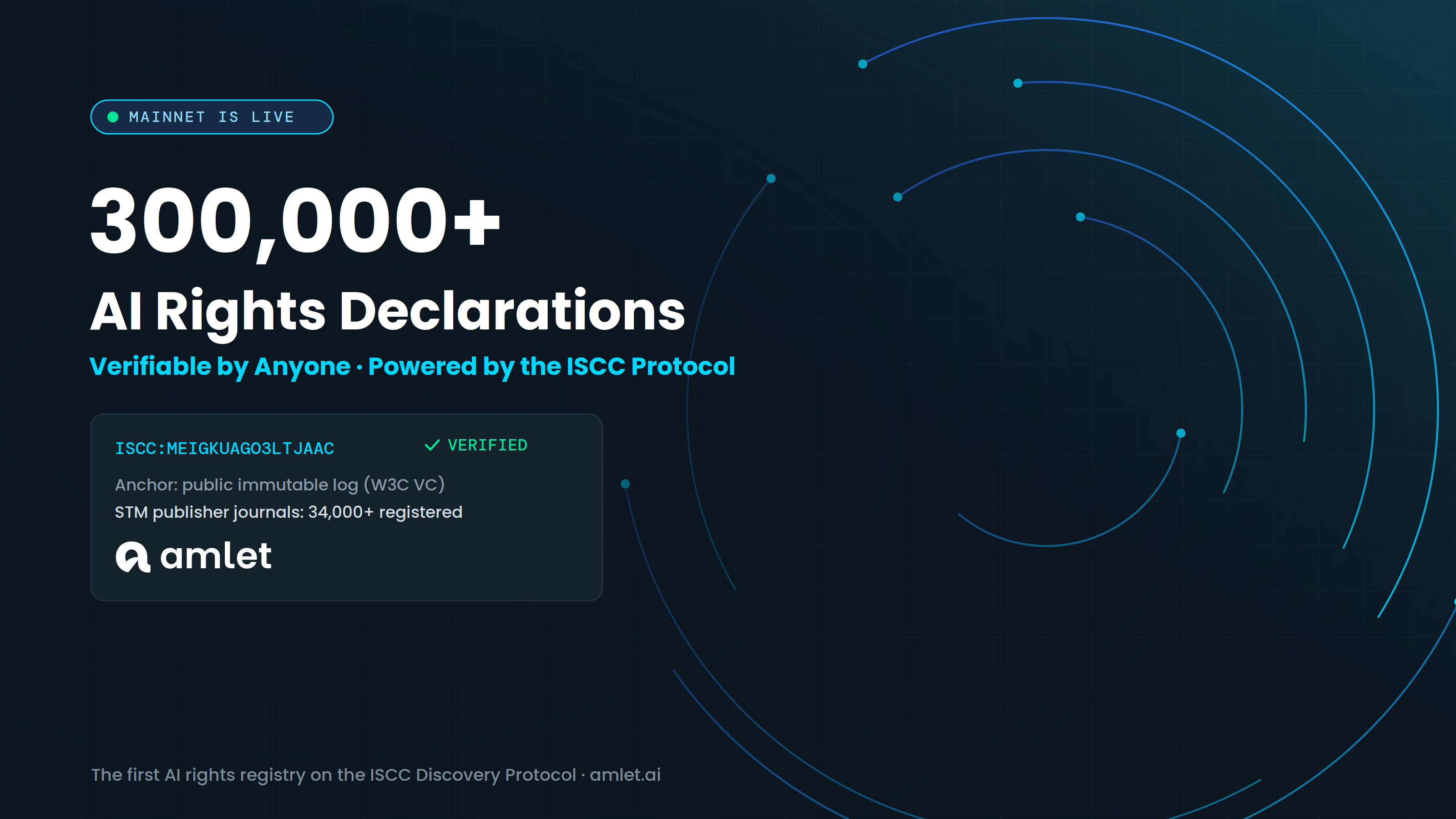
Amlet is live as the first AI rights registry on the ISCC Discovery Protocol.
The registry holds more than 300,000 AI rights declarations. Over 34,000 of those are journal assets from a major STM publisher.
Every declaration is discoverable by AI companies directly from the content itself, using open source ISCC fingerprinting. No metadata required.
Every declaration is digitally signed by the publisher, by a distributor acting for them (or by Amlet where a publisher asks us to), then hashed, timestamped, and anchored in a public log that anyone can inspect.
Because of the protocol, those declarations stay discoverable and auditable even if Amlet disappears. Publishers who join face no counterparty risk and no lock-in.
Let me walk you through how it works and why it matters.
Why we built this
Book Publishing, like every content industry, runs on copyright. That worked when copies were physical, or packaged into digital formats, and use was visible. It stopped working when content became something machines consume: built into datasets nobody publishes, stripped of metadata in transit, and retrieved at inference time. Today, publishers have no way of knowing whether their catalogue is trained into a model, whether it is being served to users, or on what terms.
With the right infrastructure in place, publishing will come out of it stronger. The industry has watched this happen before: a new distribution layer appears, someone else builds the gate, and everyone pays to pass through it.
We are building Amlet on open technology because control belongs with the people who make the work, not with whoever owns the gate. A business built without lock-in is simply a better business.
Which leaves a practical question: how do publishers and AI companies actually come to terms?
Right now, mostly in court. Publishers and AI companies are suing each other more than ever, because when there is no infrastructure for permission, litigation becomes the infrastructure. But litigation is slow, expensive, impossible to scale, and available only to the largest players. It makes for a terrible protocol, and we can do better.
Our approach is to:
Give every digital asset a verifiable identity.
Let every publisher attach machine-readable AI rights to that identity.
Make those declarations available in a single query to anyone who needs to clear content for their models.
An AI company can then check the terms automatically, at the scale it operates, using only the content it already has, without negotiating with each publisher one at a time. Once that layer exists, compliance gets far cheaper than conflict, and content stops being a contested scrape target. It becomes a licensable asset with a clear owner and clear terms.
How a declaration works
Here is one of those declarations, live on the registry right now:
https://amlet.ai/asset/meigkuago3ltjaac
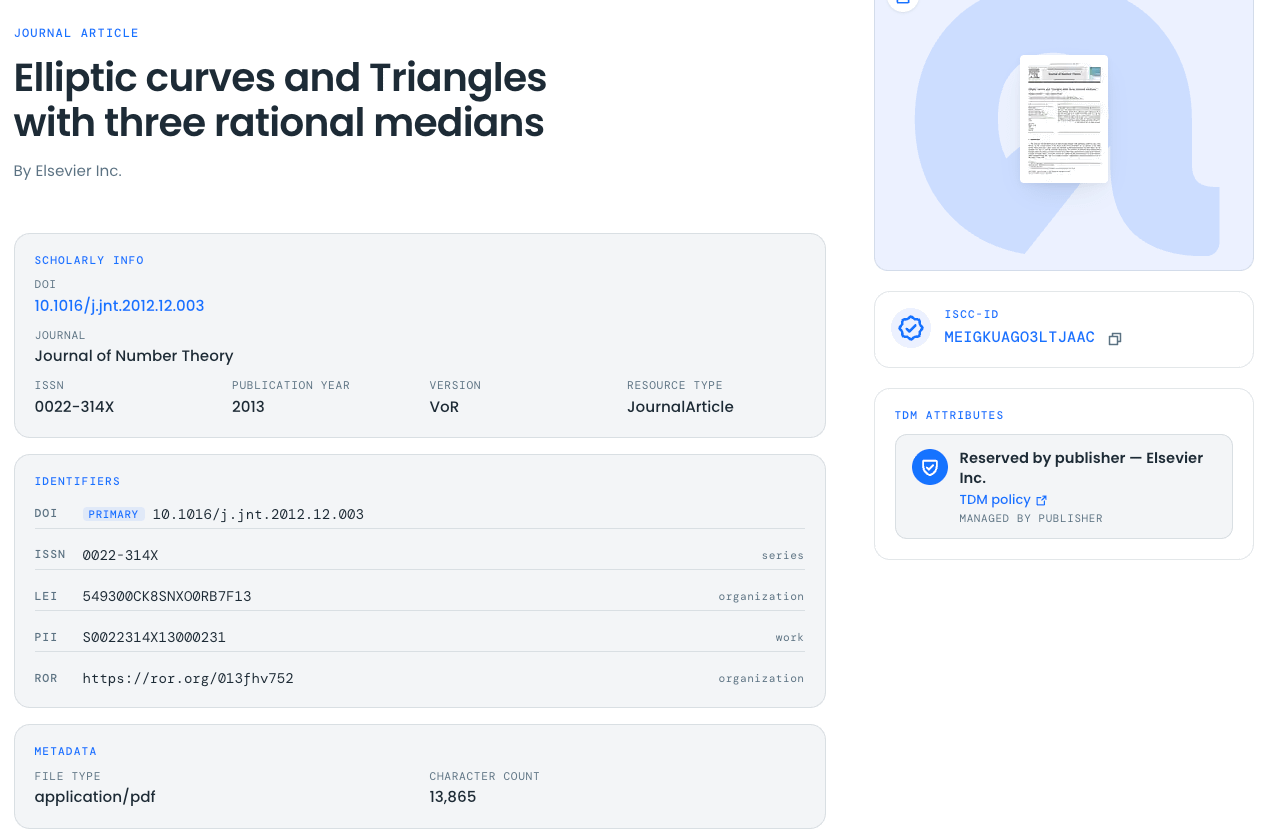
Every digital asset registered on Amlet gets an ISCC, a content-derived code under ISO 24138:2024. The code is computed from the content itself, so it cannot be stripped, forged, or lost. Start from a file an AI company is training on or serving to users, and the fingerprint alone leads back to the rights attached to it. That works for an EPUB, a PDF of a research paper, an audiobook file, a cover image, a music track, or any other digital asset.
Crucially, the unit here is the asset, not the work.
We do not fingerprint the abstract idea of a book, we fingerprint the specific file. The EPUB, the PDF and the audiobook of the same title are three separate assets with three separate codes, and a publisher can declare different AI rights for each of them. That is the level at which AI companies actually encounter content, so it is the level at which rights have to be resolvable.
Fingerprinting is the only approach that holds up in practice. Models are built from scraped datasets and scanned books, and metadata falls off somewhere along the way. The fingerprint is what gets you back to the owner and the terms they declared.
It matters just as much who owns that fingerprint. If the technology is proprietary and controlled by one company, the publisher has simply swapped one gate for another. Ours is open source, which means anyone can add a compliance layer to their AI system quickly, with no lock-in, no dependency, and no permission from us or anyone else.
What the ISCC Discovery Protocol does
The ISCC Discovery Protocol (IDP) is an open protocol that lets independent registries work as one. Each runs its own business and answers for its own content, but a query to any of them reaches all of them.
Amlet is the first AI rights registry for the book trade and STM publishing. We expect more to follow, built for different sectors, use cases and jurisdictions, and we want them to. What matters is that they interoperate, because no AI company is going to query 20 registries in 20 different ways. They want to ask once and get an answer, and that is what the IDP makes possible.
Drop a file into any connected registry, an EPUB, an audio file or an image, and you get back the rights reservations held across every registry on the network, in one interaction.
The protocol does this by transparently recording who declared what content, at what time, and where to find the related metadata and services. It also supports self-sovereign signing and timestamping of ISCC declarations.
Why nobody has to trust us
Neither publishers nor AI companies have to trust Amlet, or any other operator building on the IDP.
Each declaration is digitally signed, and who holds the signing key is up to the publisher. Large publishers usually sign for themselves, and that is the strongest form, because first-party signed data is worth more to an AI company than an attestation made by someone else. Not everyone can or wants to manage their own keys, so distributors can sign on behalf of their publisher clients, and Amlet can sign where a publisher asks us to. Every declaration records which of these applies, so an AI company can filter for first-party signatures alone or accept the wider set.
This is the inclusion proof for the declaration linked earlier:
https://monitor.iscc.io/inclusion/?iscc_id=MEIGKUAGO3LTJAAC
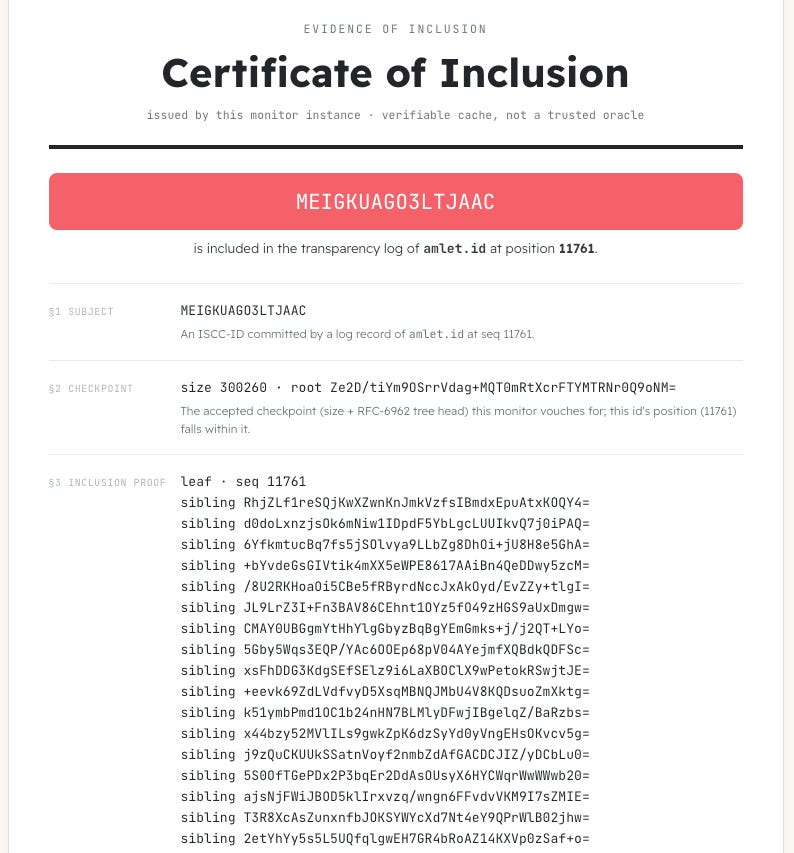
Follow it and you can confirm for yourself that the declaration exists, when it was anchored, and that nobody has altered it since. Every declaration also ships as a W3C Verifiable Credential, so the publisher can hold an offline proof that does not depend on the issuing IDP server. .
For the first time, any AI company can confirm who declared which content, when, and on what terms, without asking permission from anyone, including us. The record sits in a public log that is open source and controlled by no single company, ours included. If we vanished tomorrow, every declaration would still be there and still be checkable.
Rights infrastructure only works if nobody has to trust a gatekeeper.